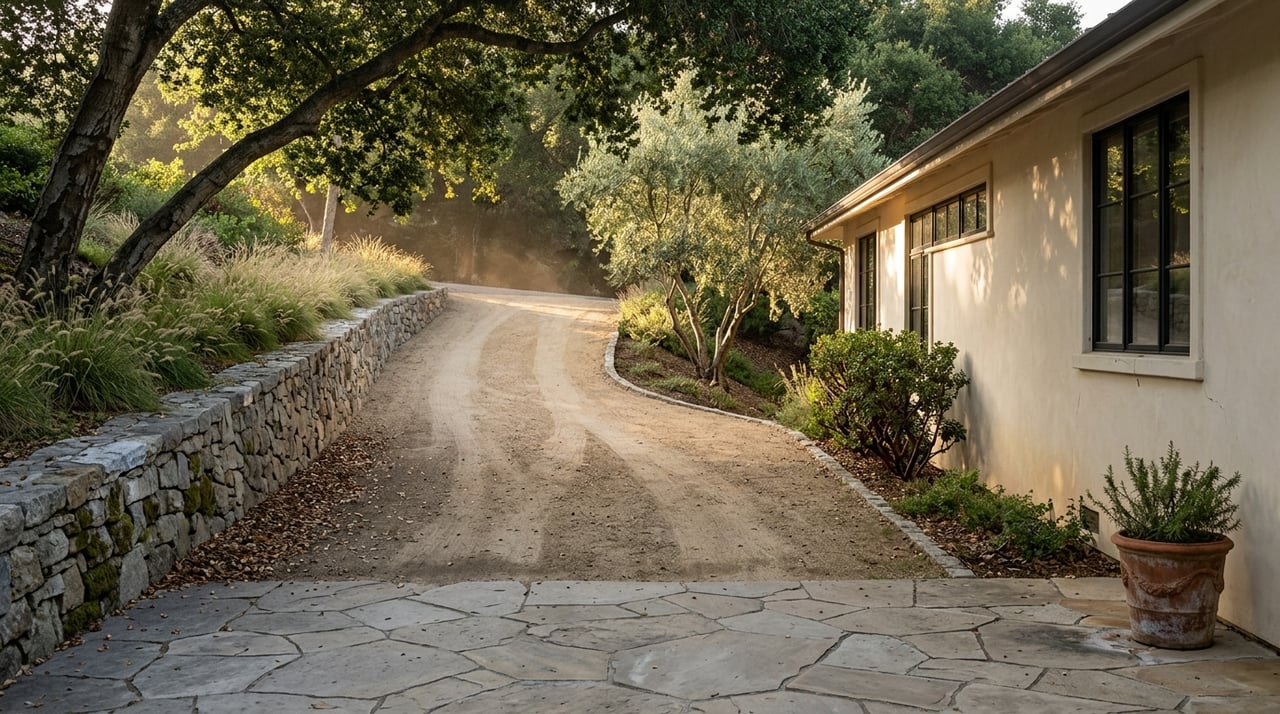
Drive Agoura Road on a weekday afternoon this month and you will hit a flagger before you hit Liberty Canyon Road. One lane, a slow crawl past orange drums, a glimpse of a construction fence where the road dips toward the creek. It has looked roughly like this on and off for more than a year. It will not look like this much longer.
That timing matters more than it seems, because the thing being built above and beside that lane closure is not a widening project or a utility upgrade. It is the Wallis Annenberg Wildlife Crossing, the vegetated bridge over the 101 that is set to become the largest urban wildlife crossing in the world, and it sits close enough to Agoura Road that the two projects have been tangled together for the length of the construction.
For anyone comparing homes along that corridor right now, this creates a genuine timing question that a median price cannot answer: how much of what you're seeing in a listing's price reflects a market still finishing a disruptive project, and how much already reflects what the corridor becomes once that project opens.
What's actually happening on Agoura Road this month
The crossing has been built in two stages. The first, the vegetated span directly over the ten lanes of the 101, wrapped in mid-2025. The second and more technically difficult stage is the one still finishing now: a tunnel connection under Agoura Road itself, threading around heritage oak trees and a buried waterway that project engineers have taken to calling No-Name Creek, with utility lines for the Las Virgenes Municipal Water District relocated along the way.
That work is what has produced the periodic daytime lane closures and detours residents near Agoura Road have lived with for over a year. Caltrans has consistently said stage two is scheduled to wrap in 2026, and reporting through the summer has pointed to a fall completion, with a public opening targeted for later in the year. In other words, as of this month, the corridor is in the closing stretch of a disruption that has already run its course through most of its worst phase, not the middle of one just getting started.
Stage two threads roughly 175 feet of tunnel under Agoura Road, rebuilt around a small grove of heritage oaks and a buried waterway crews have nicknamed No-Name Creek. The project's landscape architect has called this south-side connection the trickiest part of the entire build.
The number that doesn't add up
Here is where the standard market snapshot starts to mislead rather than inform. Over the three months ending May 2026, the median sale price across Agoura Hills climbed to $1.4 million, up 11 percent from the same period a year earlier. That reads like a market getting stronger. But the median sale price per square foot over that same window actually fell, down 11.6 percent year over year, even as the headline price rose. Sales volume slipped too, with 46 homes changing hands in May 2026 compared to 53 the year before, and the typical listing still took 44 days to sell.
A rising median alongside a falling price per square foot is not a contradiction so much as a signal that the mix of what's selling has shifted. Larger, higher-priced homes are moving the median up while the typical dollar-per-square-foot buyer is paying less for comparable space, or fewer of the smaller, corridor-adjacent listings are trading at all while construction wraps up around them. A single citywide number cannot tell you which. It blends large-lot estates in Old Agoura with tract homes a mile away and everything actually fronting Agoura Road into one line.
Three corridors, three different realities
Agoura Hills is not one market. It is at least three, and each has a different relationship to the crossing right now.
| Area | Relationship to the corridor | What buyers are dealing with today | What changes once the crossing opens |
|---|---|---|---|
| Streets closest to Liberty Canyon Road and Agoura Road | Directly adjacent to the construction | Periodic daytime lane closures, detour signage, occasional dust and equipment noise | Closest proximity to a globally covered conservation landmark, walking distance to future docent tour access |
| Old Agoura | A short drive from the corridor, on larger equestrian-zoned lots | Limited direct exposure, mostly indirect through occasional connecting-road detours | Unchanged rural, large-lot character, with the crossing as a nearby amenity rather than a daily fixture |
| Interior neighborhoods set back from Agoura Road | Removed from the construction footprint | Little to no visible impact from either the closures or the future opening | Benefits mostly through the citywide profile lift that comes with Agoura Hills being home to a widely reported landmark |
The homes absorbing the most friction today are, almost by definition, the ones sitting closest to what will soon be a rare kind of amenity. That is not a coincidence. It is the same stretch of road on both counts.
Why the comps don't catch this
A typical comparative market analysis pulls recent sales within a radius or a similar square footage band, not by proximity to a specific construction zone. That means a listing agent pricing a home on or near Agoura Road right now may be leaning on comps from Morrison Ranch or interior Old Agoura streets that never saw a detour sign, which can either understate the near-term friction a buyer is walking into or, just as often, fail to credit the seller for a completion date that is now measured in months rather than years.
This is the kind of detail that does not show up on a portal listing page. It shows up when someone who tracks this corridor pulls sales specifically from the blocks touching Agoura Road and Liberty Canyon Road, separate from the broader Agoura Hills pool, and looks at how those homes have priced and moved relative to the rest of the city over the same stretch of months.
The window closes this fall
If Caltrans holds its own timeline, the disruption that has shaped daily life on this stretch of Agoura Road for more than a year is set to end within the next few months, with the full crossing expected to open to wildlife before the end of 2026. Reserved docent-led tours of the site are already available for anyone who wants an early look. A buyer closing escrow this fall, on a typical California timeline, could plausibly move in around the same season the crossing itself opens.
The project's original $92.6 million construction budget moved forward as a public-private partnership, with Caltrans working alongside the National Wildlife Federation, the National Park Service, the Annenberg Foundation, and the California Wildlife Conservation Board. Fundraising for the crossing traces back to 2016, six years before the ceremonial groundbreaking in 2022. That is a different funding structure than a typical municipal road widening or utility upgrade, and it is a reasonable thing for a buyer to understand before assuming this is the kind of project that eventually shows up as a new line item on a property tax bill.
None of this is a promise about future value. Construction ending on schedule is not guaranteed, and a landmark next door does not automatically move a comp. What it does mean is that the friction a buyer sees on a drive-by showing this month, the cones and the flagger and the one-lane crawl, has a documented end date that is close, not indefinite, and that end date happens to line up with the arrival of something Agoura Hills has been building toward publicly since 2016.
A few questions worth asking before you write an offer
Will the construction show up in a seller's disclosure? California's Transfer Disclosure Statement covers known material facts about the property itself. Nearby public construction is the kind of thing a good agent raises in conversation and a buyer should ask about directly, since it will not necessarily appear as a checked box on a standard form.
Is the noise and detour pattern getting worse or better? Based on the project's own public timeline, the heaviest phase of tunnel work is what has produced the closures residents have seen over the past year, and that phase is the one nearing completion, not the one just beginning.
Does proximity to the crossing actually affect long-term value? That is not something any dataset can answer yet, since the crossing has not finished. What can be said is that the corridor closest to it is the one currently absorbing the most construction friction, and the one that will sit closest to the finished landmark once the fencing comes down.
Working with someone who tracks this corridor block by block
A citywide median is a starting point, not an answer, especially on a stretch of road that has spent the better part of a year under active construction for one of the most closely watched conservation projects in Southern California. If you're weighing a home near Agoura Road or Liberty Canyon against one a mile inland, the difference between those two decisions often comes down to details that never make it into a portal listing.
Cris Epstein has spent more than two decades reading these kinds of local shifts across Westlake Village, Agoura Hills, Oak Park, and the surrounding Conejo Valley communities, matching buyers and sellers to what a specific block is actually doing, not just what the city average says. If you're trying to time a purchase or a sale around this corridor, let's connect.